Gerrit Rietveld 1888-1964
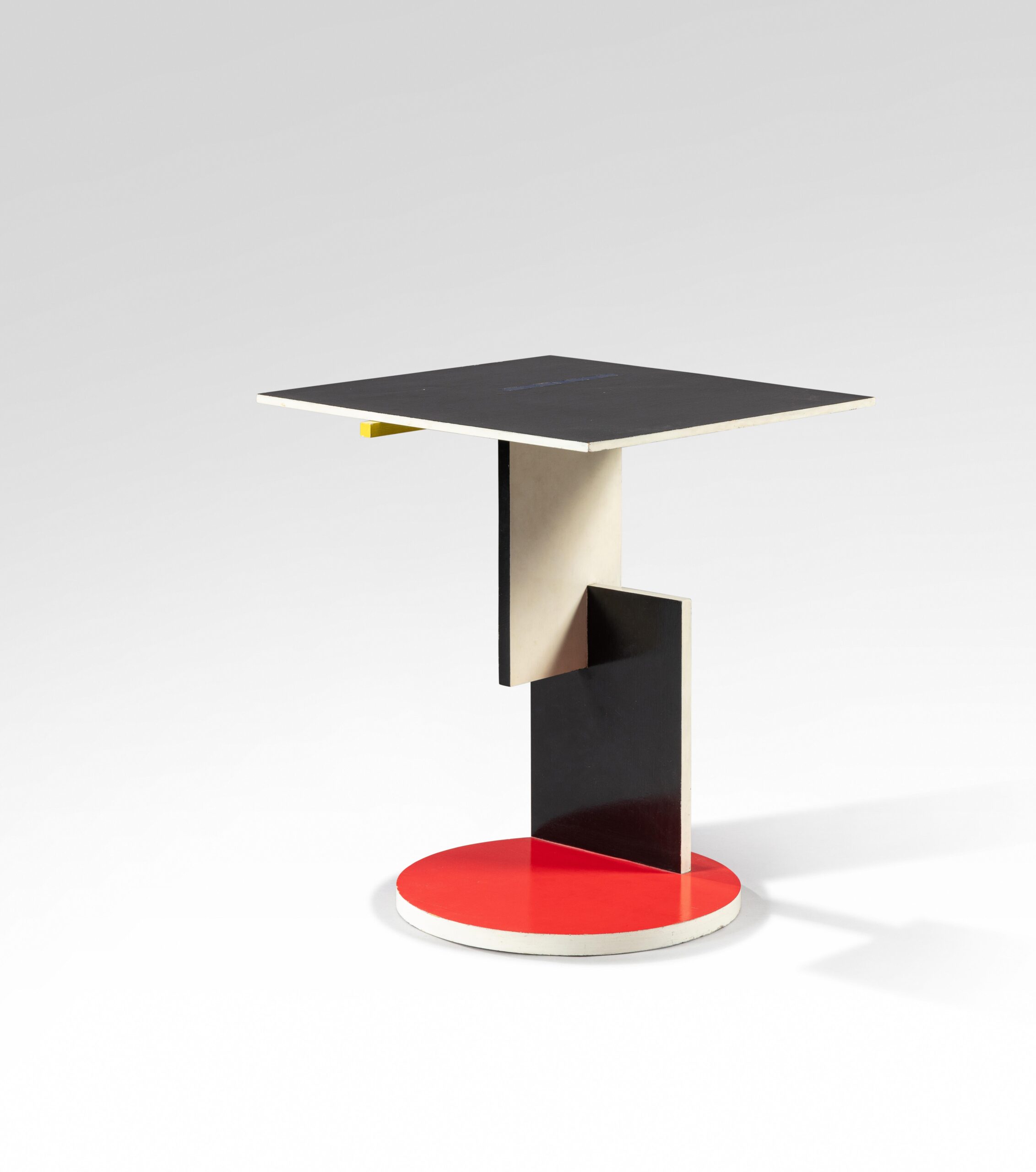
Schröder Table also called End Table, 1923.
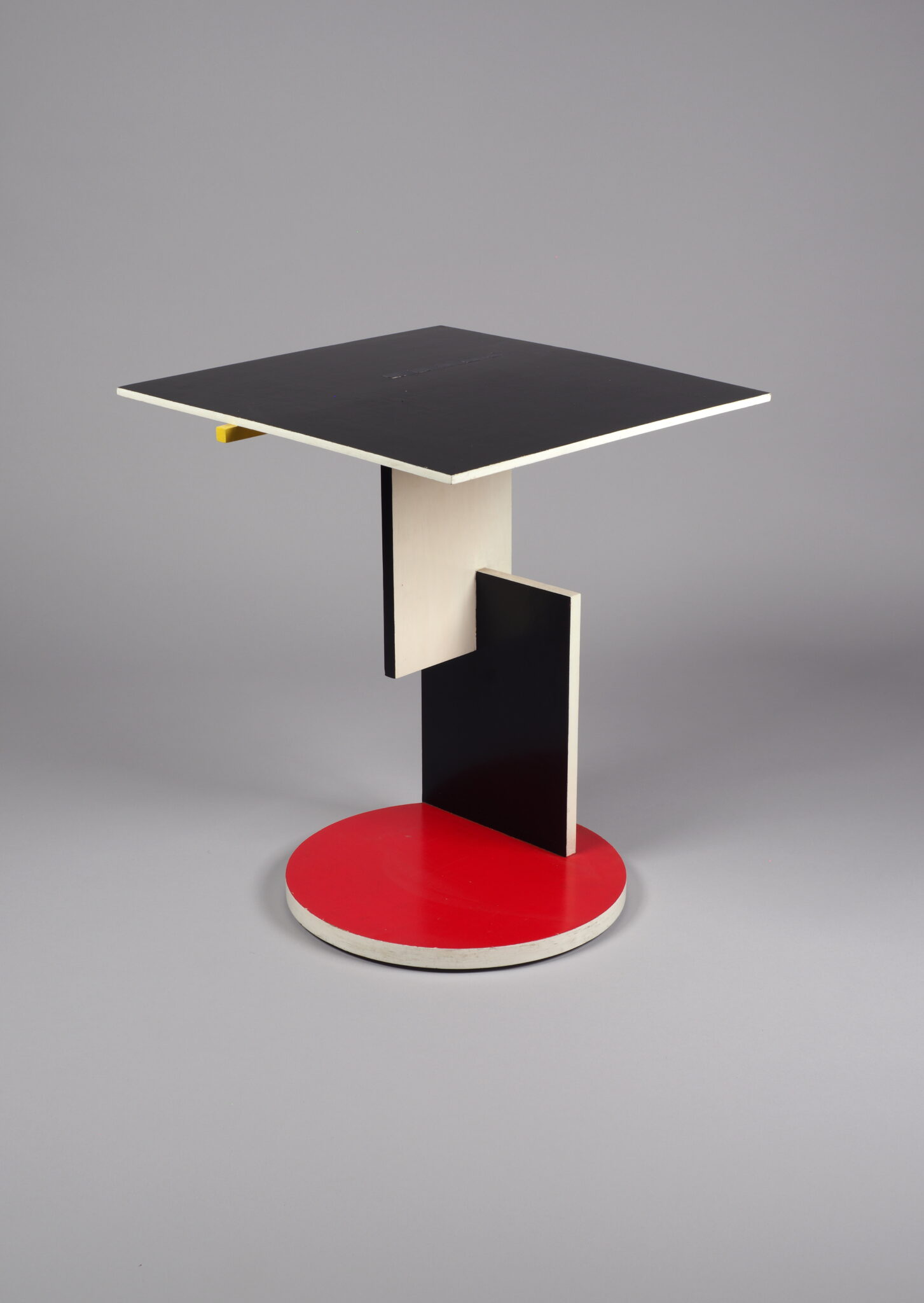
Base, frame and top made of plywood; base and top connected to the frame with visible dovetail joints; top supported by a thin, massive Beachwood slat; Painted red, yellow, blue, black and white.
Dimensions: 60 x 50 x 50 cm./23,6 x 23,6 x 19,7 Inch.
Executed by: Gerard van de Groenekan under Rietveld’s control, De Bilt, The Netherlands, 1958-1964.
Marked with: H.G.M. G.A. v.d. GROENEKAN DE BILT NEDERLAND at the base.
Provenance:
Truus Schröder ca.1958-1985, heirs of Truus Schröder 1985-2024, Sotheby’s Paris 2024
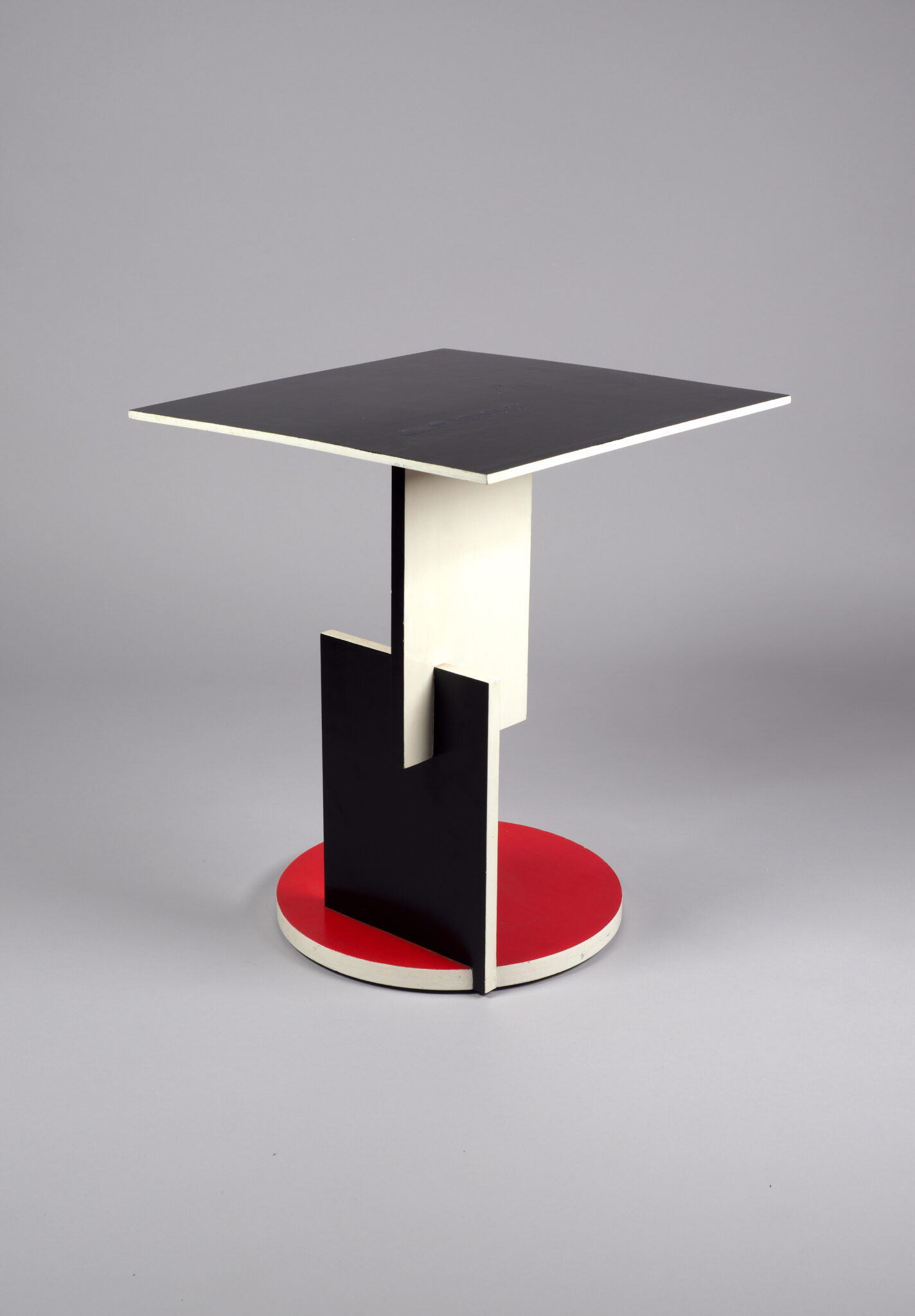
The ‘Schröder Table’ is a true representative of the Aesthetic movement ‘De Stijl’. It is an asymmetrical balance act of geometric forms in primary colors that points out space rather than enclosing it.
With the Beach Buggies, the Wheelbarrows and the Schröder Table, all designs from 1923, circles now play a prominent role in the design. Rietveld also for the first time used different primary colors with these designs to emphasize each separate part of the construction. A method he applies in the same year for the monochrome ‘Slatted Armchair’, he designed already in 1918, changing it into ‘The Red and Blue Chair’, by which it became a world-famous icon of the Aesthetic movement ‘De Stijl’. With the Beach Buggies and Wheelbarrows, both being designs for children, he possibly first felt the freedom to experiment with this color scheme.
 Drawing from the archives of the ‘Centraal Museum Utrecht’
 Photo: 1925, the ‘End table’ in the sitting-dining area of the Rietveld-Schröder House with Truus Schröder and her daughter Hanneke, from ‘Marijke Küper/Ida Van Zijl, ‘The complete work’, p. 100.
Provenance:
The table here on offer has a special provenance because it originates from the Rietveld Schröder house. It was part of the estate of Truus Schröder, the owner and resident of the Rietveld Schröder house. She gave away the first copy of this design from 1923 as depicted at the photo above to a friend of her (information from a former curator of the ‘Centraal Museum Utrecht’). She commissioned Rietvelds regular cabinetmaker Gerard van de Groenkan to make the table on offer here during the period that she and Gerrit Rietveld lived together in the Rietveld-Schröderhuis from 1958 until his death in 1964.
Sold at the art fair TEFAF 2026

