Gerrit Th. Rietveld (1888-1964)
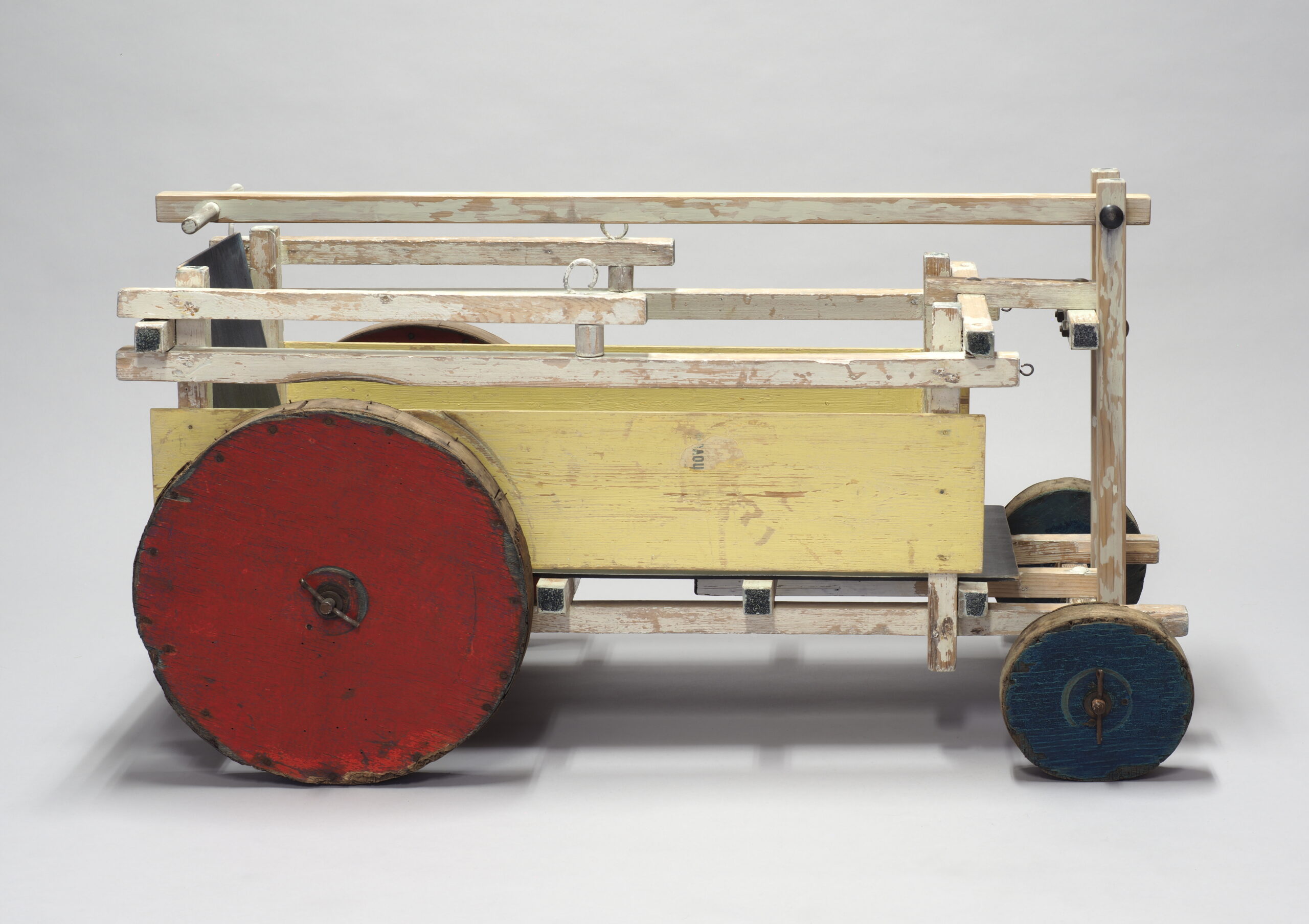
Strandwagen/Beach Buggy, 1922-1923
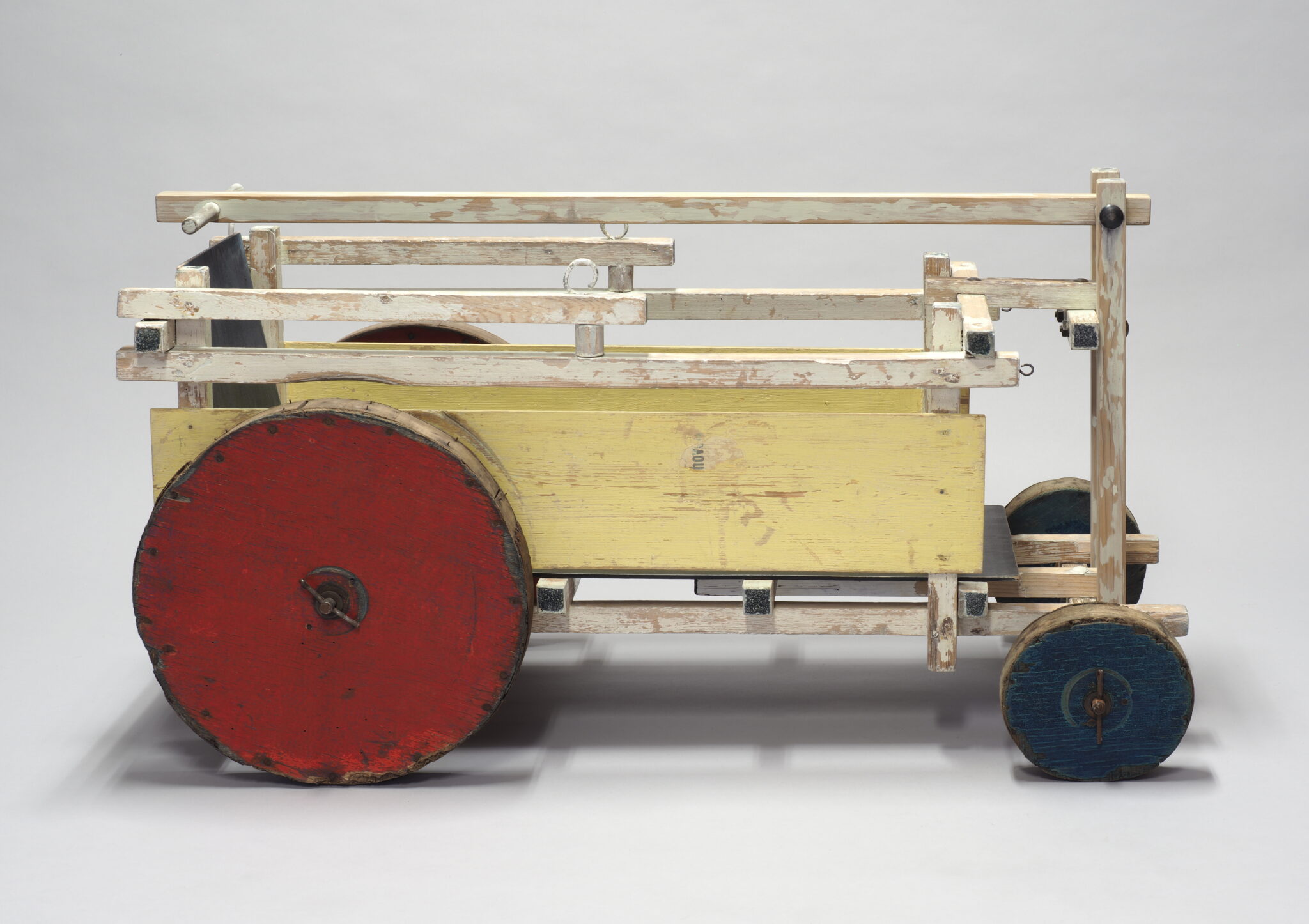
Framework of pine wood slats supporting a plywood seating and backrest, with wheels made of wood and plywood connected to the frame with axes of solid steel. Painted red, yellow, blue, black and white.
Dimensions:
54,5 x 60 x 102,5 cm./21,5 x 23,6 x 40,4 Inch.
Executed by:
Rietveld’s regular cabinetmaker Gerard van de Groenekan, under Rietveld’s control, Utrecht, The Netherlands, second half of the 1920s.

Beach Buggy
One of the highlights of our collection is this early copy of the Beach Buggy. A striking design object for children, in primary colors from the 1920s, and a true representative of the Aesthetic Dutch Modernist movement ‘De Stijl’.
It is one of the three oldest surviving examples of this design and still shows a fair amount of its original red, yellow, blue, black and white lacquer.
This Buggy was passed on by inheritance within a Dutch family from the second half of the 1920s to 2025 and is, according to the renowned Rietveld Restorer Jurjen Creman, one of the best documented Rietveld-objects he ever came across.
Slatted Armchair and Circles
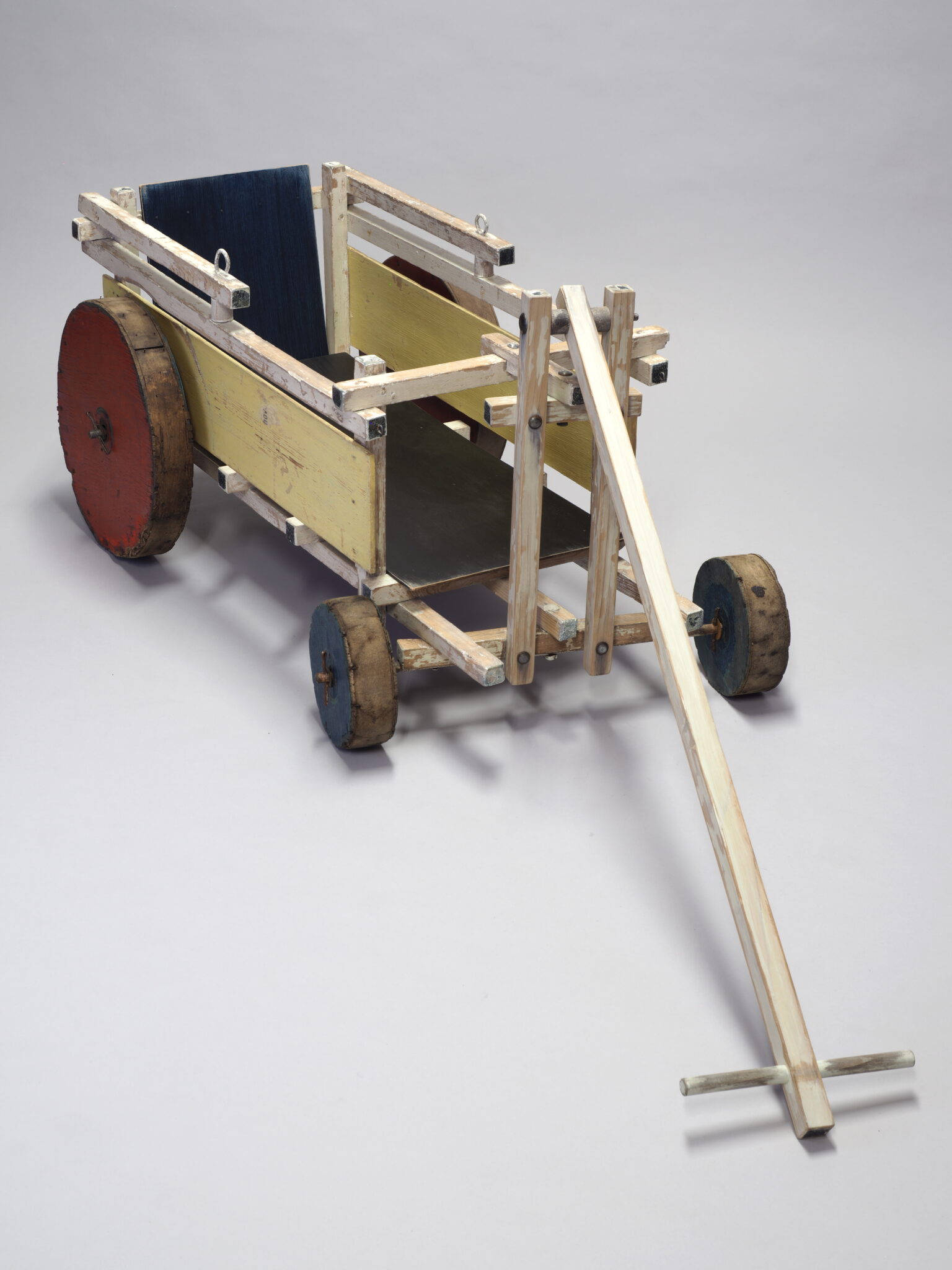
The Beach Buggy from 1923 is composed of the same visual elements as one of Rietveld’s first ground breaking designs the ‘Latten-leunstoel’ (Slatted Armchair) from 1918, except that circles now play a prominent role in the design
Rietveld didn’t often used circles in his designs, but in 1923, in addition to the Beach Buggy, he also designed a child’s Wheelbarrow and the famous Schröder Table, in which the circle played a prominent role. Ludo van Halem, curator of the Rijksmuseum Amsterdam, has previously suggested that the meeting between Rietveld and the Russian artist El Lissitzky (1890-1941), in the same year, may have been a source of inspiration for this. (L. van Halem, ‘de stoel van til, til brugman en de stijl, RMA Bulletin 2013)
Primary Colors
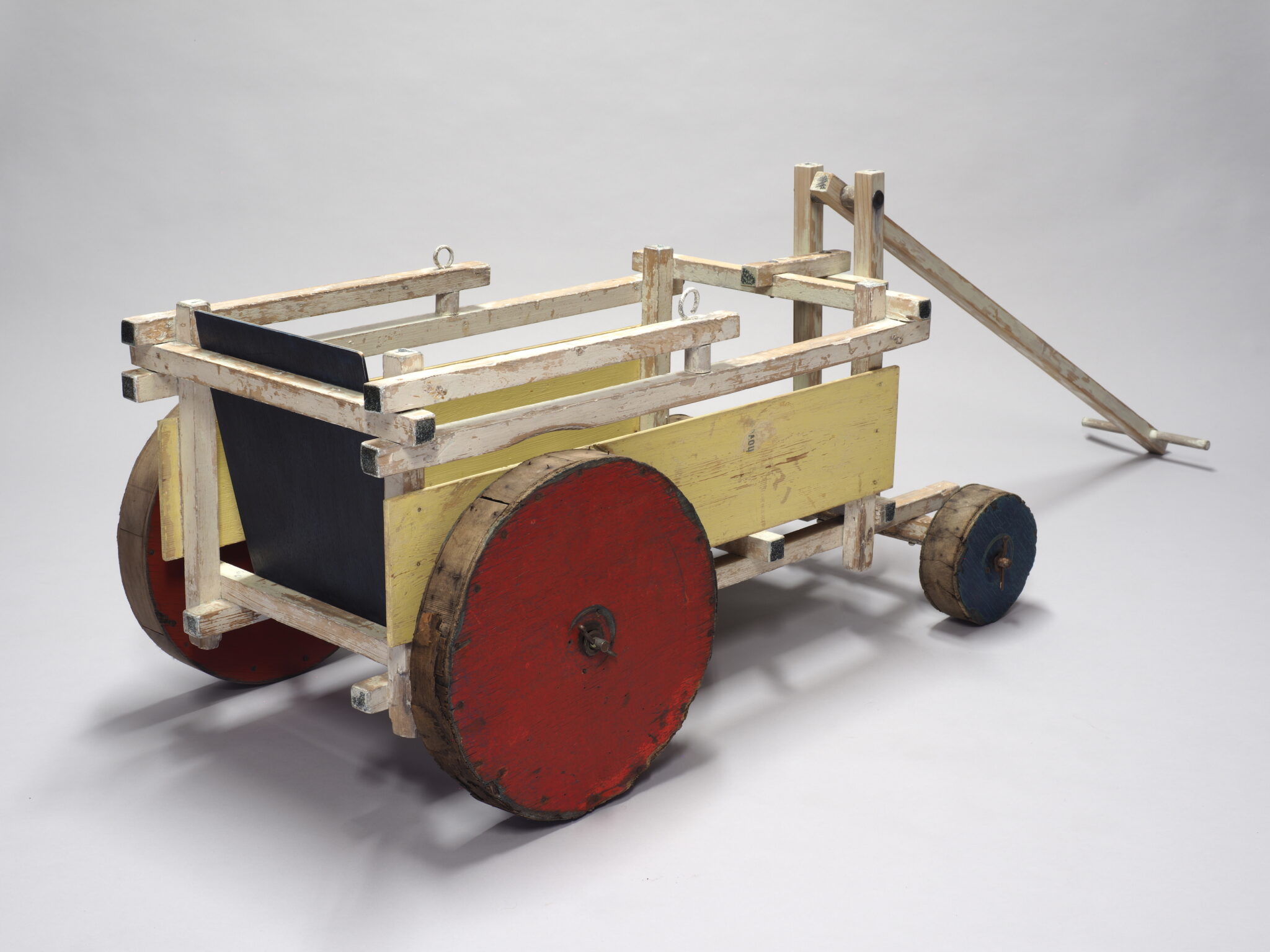
The Beach Buggy immediately stands out because of its bright primary colors used to emphasize each separate part of the construction. A method Rietveld also applies for the first time in 1923 for the monochrome ‘Slatted Armchair’ from 1918, changing it into ‘The Red and Blue Chair’, by which it became a world-famous icon of the Aesthetic movement ’De Stijl’.
While designing the Beach Buggies and Wheelbarrows, both being designs for children, Rietveld possibly first felt the freedom to experiment with this color scheme. The buggy here on offer, still shows a fair amount of its original red, yellow, blue, black and white lacquer.
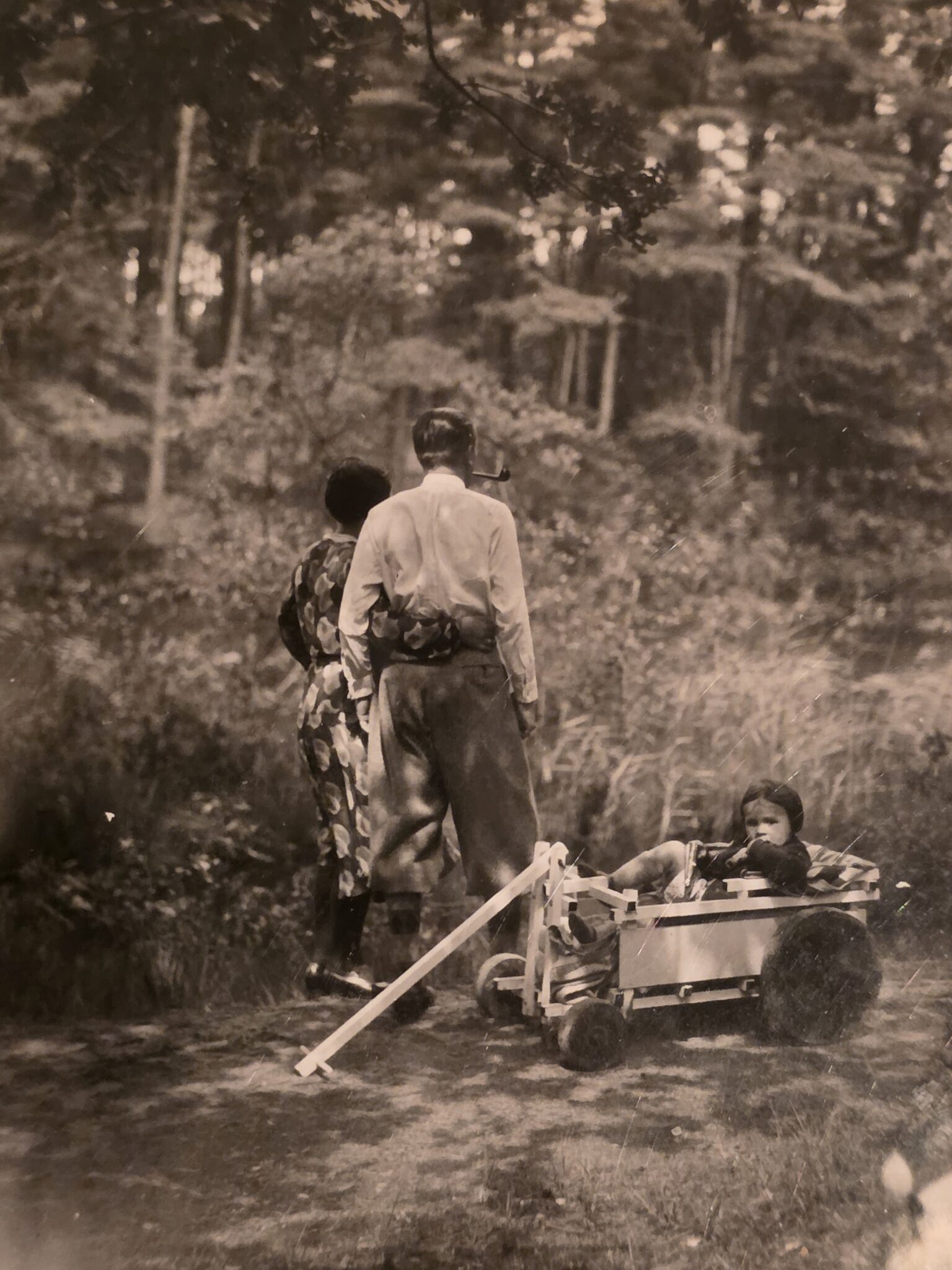
Very well documented provenance:
Art-historically significant design objects like this Beach Buggy often achieve the status of art object later in history. Yet, in the period in which they were designed, they were usually acquired by their first owners as utilitarian objects, resulting in little preserved documentation from the object’s early history. The family in which this Beach Buggy was passed down from generation to generation is an exception to this rule.
The many surviving historical photos of this buggy, taken in various locations, show that its first owners considered it a very special utensil, to say the least. The oldest photos date from the early 1930s. Some were taken in Dutch coastal towns and demonstrate that the buggy was actually used for its intended purpose: to transport children to and from the beach.
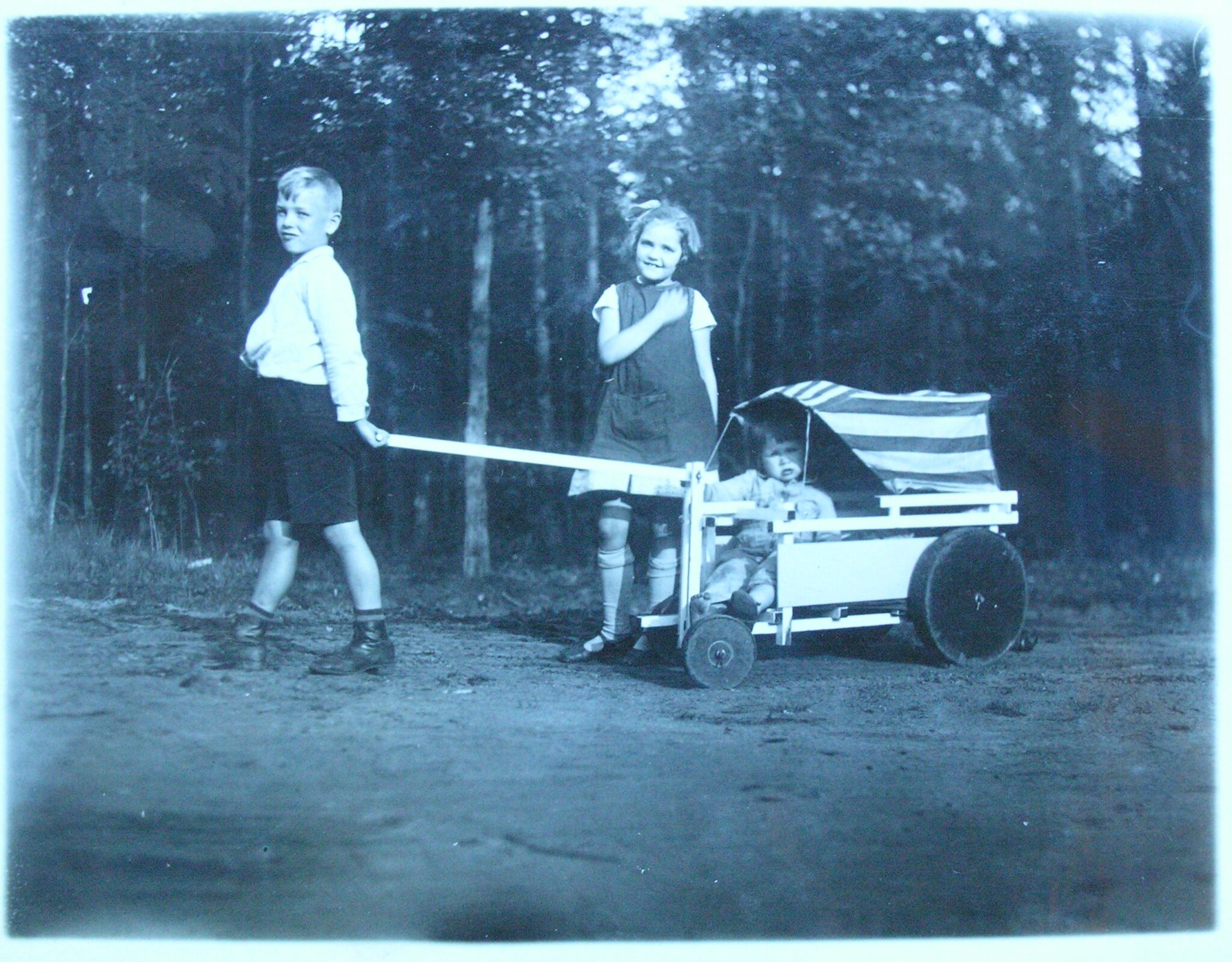
Preservation, repairs, and restoration within the family.
Most historical photos show the Beach Buggy being pulled along sandy paths and cobblestone roads. It’s not surprising that this severely tested the construction of the buggy, being assembled from simple wooden slats and wooden wheels without suspension. There were also photos taken of the repairs and restorations that followed this intensive use. By continually maintaining and repairing the buggy and documenting these efforts, the subsequent owners within the family, have preserved this important design object and its history for future generations.
Atelier Creman
The repairs and restorations carried out in the past did not always meet the high standards currently required for the restoration of such an important museum quality object. Therefore, several years ago, the youngest generation of owners, commissioned the renowned Rietveld-specializing restorer, Jurjen Creman of Atelier Creman in Amsterdam, to conduct a museum-worthy, complete restoration of their heirloom. The starting point is to remove what is not original and, where original parts have been lost, to reconstruct them in a historically responsible way so that after the restoration the original condition of the buggy is approximated as closely as possible.
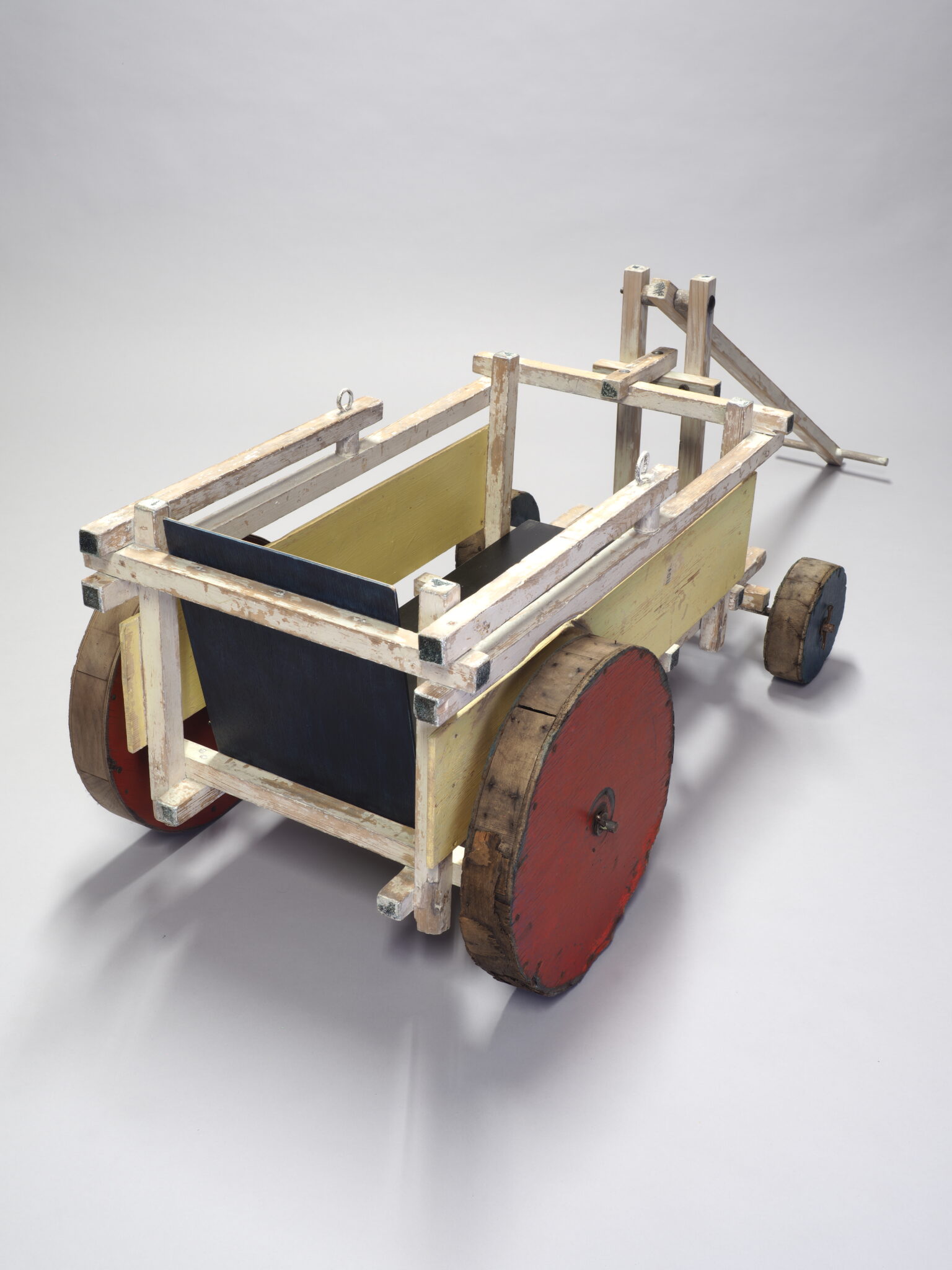
Inventory of the surviving pre-war examples
In preparation for the restoration, Atelier Creman inventoried how many Beach buggies were made before WWII and how many have been preserved in private and museum collections.
Conclusion:
There are 7 pre-war examples depicted in archival material/known to have ever been made, of which 3 still exist. One of these is in the collection of the Centraal Museum Utrecht, the other two are in private hands. The Stedelijk Museum Amsterdam and the Victoria & Albert Museum in London have an example in their collections that was made after the death of Gerrit Rietveld.
From the two pre-war examples in private hands, the Beach Buggy offered here is by far the most original, and the only one whose original solid wooden side panels and a large part of the original lacquer in red, blue and yellow have been preserved.
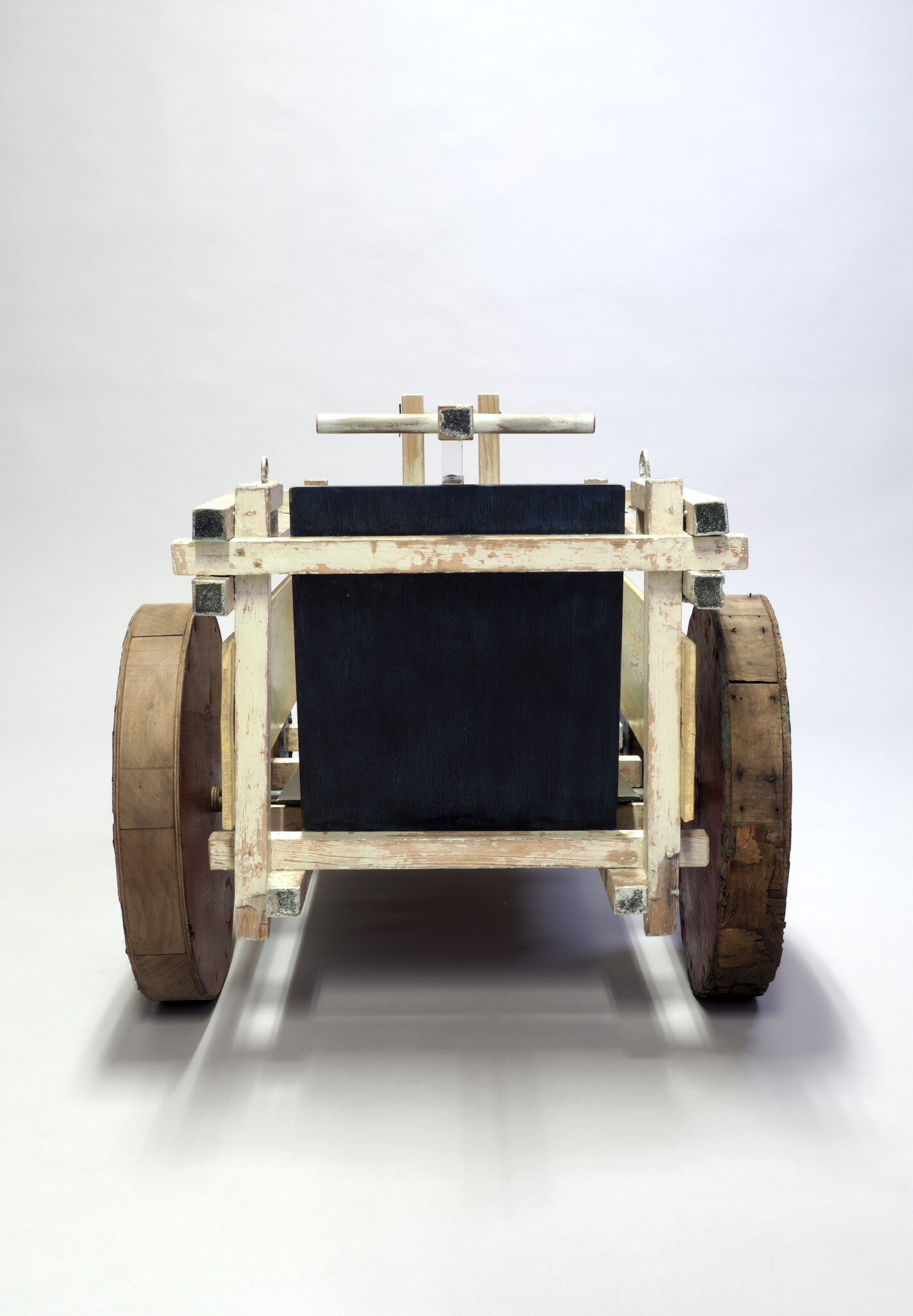
Lacquer Research by RCE
The layers of lacquer, applied to the Beach Buggy over the years, were examined in 2022 by the RCE (Cultural Heritage Agency of the Netherlands). Based on these findings, Atelier Creman removed various overpaintings from the slatted frame, the side panels, and the wheels, revealing the original paint layers again. A report from the RCE is available.
Reconstructions
Throughout the nearly century-old history of this Strandwagen, parts have been replaced several times to preserve it, namely: the wheels, the rear axle, the seat and backrest, and the drawbar.
After studying historical photos from the family and photos and original drawings from the archives, it was determined that, to approximate the original condition of the buggy as closely as possible, it would be beneficial to reconstruct the previously replaced parts. These reconstructions were carried out by Atelier Creman. Three original wheels, which had been kept by the family, were stripped of their over-paintings and mounted back to the buggy. The finish of the reconstructed components has been deliberately aged to create a credible overall impression.
Available reports:
– Beach Buggy research, research into how many examples were made, are known to have survived and how they were executed, Atelier Creman, Amsterdam.
– Condition report on the Beach Buggy before restoration, Atelier Creman, Amsterdam.
– Research report 2022-059, National Heritage Laboratory, The painted finishes of a Beach Buggy by Gerrit Rietveld, RCE – Cultural Heritage Agency of the Netherlands, Ministry of Education, Culture and Science.
– Restoration report, Atelier Creman, Amsterdam.

